Pensoft has been awarded the Seal of Recognition for the FAO AGRIS Active Data Provider of the Year for 2027. The seal is granted by the Food and Agriculture Organisation of the United Nations through its AGRIS initiative, and it recognises institutions that consistently share open-access agricultural research with the global community.
Notably, Pensoft joined the FAO AGRIS network back in 2024, and the organisation has renewed our seal every year since, a recognition we’re proud to have kept.
What has changed is the scale of our contribution. In 2024, Pensoft’s records on AGRIS numbered just under 15,000. Today, that figure has doubled to nearly 30,000, drawn from all 51 of our journals that fall within the scope of FAO AGRIS. The subjects covered are wide-ranging, spanning taxonomy, biodiversity, conservation and biogeography – these are all areas that feed directly into sustainable agriculture and natural resource management.
Through AGRIS, this research travels well beyond our own journals to researchers, policymakers and practitioners worldwide, adding to the shared pool of open knowledge that supports global food security and environmental sustainability. We’re glad to keep contributing to that effort, and look forward to continuing our work with FAO AGRIS in the years to come.
About FAO
The Food and Agriculture Organisation (FAO) is a specialised agency of the United Nations that leads international efforts to defeat hunger. Its goal is to achieve food security for all, ensuring that people have regular access to enough high-quality food to lead active, healthy lives. With 194 members, 193 countries and the European Union, FAO works in over 130 countries worldwide.
About Pensoft
Founded in 1992 “by scientists, for scientists,” Pensoft is an academic open-access publishing company well known worldwide for its cutting-edge publishing tools, workflows and methods for text and data publishing of journals, books and conference materials. In 2010, Pensoft became the first scientific publisher to introduce semantic enrichments in scholarly publications. Through its Research and Technical Development department, the company is involved in a range of research and technology projects.
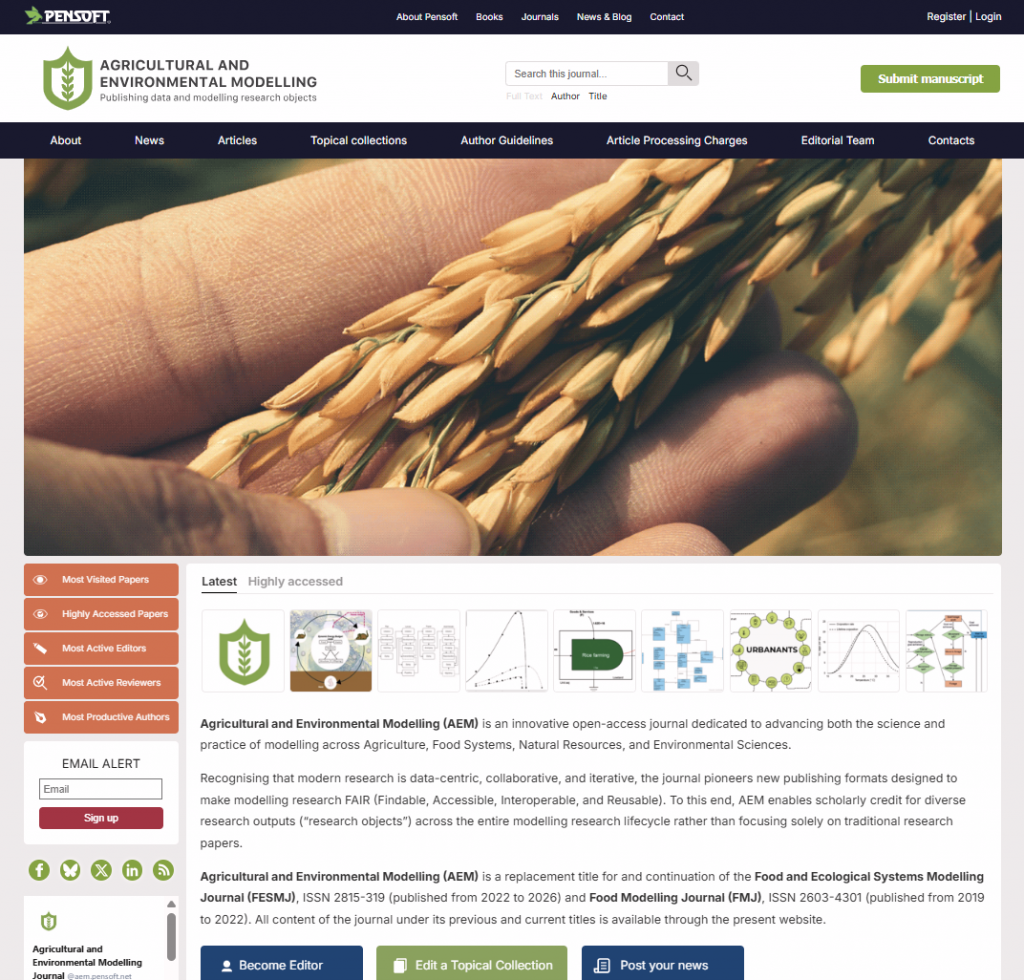
Today marks the official relaunch of the Food and Ecological Systems Modelling Journal (FESMJ) under a new name – Agricultural and Environmental Modelling (AEM), an open-access journal dedicated to advancing the science and practice of computational and mathematical modelling across agriculture, food systems, natural resources, and environmental sciences.
The first editorial published under the AEM name sets out the journal’s expanded vision, its new article types, and its call to the modelling community.
What Has Changed and What Has Not
AEM retains the founding mission of its predecessors: to make ‘modelling research objects citable, discoverable, and reusable’ and transparent. The journal’s commitment to open access, rigorous peer review, and the recognition of modelling as a first-class scientific endeavour remains unchanged. Publication in AEM remains entirely free for all authors.
What has changed is the scope and structure. The journal’s disciplinary scopenow spans the full breadth of modelling in the agricultural and environmental sciences, including management systems, production dynamics, agroecological modelling, as well as food safety, production, quality and supply-chain control, biotechnological research, socio-ecological systems, resource management and more.
Publishing the Full Modelling Lifecycle
A defining feature of AEM is its structured range of article types, designed to give formal, peer-reviewed recognition to each group of authors at every stage of a model’s development.
A complex model is not born in a single paper: it emerges through cycles of formal specification, software implementation, calibration, testing, and application, often carried out by different teams across different project phases. Each of those steps represents genuine scientific work; each deserves recognition.
– reads the editorial
Among the most distinctive publication types is the Formal Model, which offers a citable recognition for foundational mathematical and conceptual design. Alongside the more standard article types, such as Review Article; Research Article; and Short Communication, AEM also welcomes contributions framed as Model Testing and Calibration; Model Implementation and Documentation; Software Description; and Data Paper. For each article, the journal’s team has provided an article template to assist authors.
Commitment to Open Science and Reproducibility
AEM is built around the FAIR principles – Findability, Accessibility, Interoperability, and Reusability – these are applied to data, code, and models as peer-reviewed outputs. As such, the journal mandates that all underlying data and source code are made openly available; while machine-learning methods must follow the DOME-ML reproducibility guidelines.
Overview diagram of the conceptual population model for APODEMUS. The model simulates the wood mouse life cycle, growth and reproduction. Landscape composition is captured by habitat types (numbers) and influences the space use of the simulated wood mice. Exposures can be linked to the use of defined habitat patches and types. Credit to Singer et al., 2026
The most recent paper demonstrates how the Formal Model article type has been utilised to describe APODEMUS, a spatially-explicit simulation model designed to improve pesticide risk assessments for the wood mouse (Apodemus sylvaticus) in European agricultural landscapes. The model provides regulators with a rigorous, transparent blueprint for evaluating how agricultural pesticides affect wild animal populations at the landscape scale.
An Invitation: Submissions and Editorial Board Applications
AEM welcomes submissions from researchers across all disciplines within its scope – whether describing a formal mathematical framework, documenting the calibration of a long-standing model, sharing data, or presenting a new computational workflow. Authors are encouraged to contact the editors directly to discuss specific publication needs.
The journal also welcomes applications from editors worldwide who share AEM’s vision. Experts willing to actively contribute to this unique journal and its community are invited to get in touch via the journal website.
Agricultural and Environmental Modelling is the first journal designed around the full lifecycle of modelling research, from formal specification to calibration, implementation, and application. Every contribution is important; every contribution is citable; credit where credit is due.
– commented the Editor-in-Chief, Prof. Christopher Topping
The renaming reflects a natural evolution of the journal’s mission. Agricultural and Environmental Modelling better represents the breadth of work it publishes – spanning the full spectrum of modelling across agricultural, food, and environmental sciences – and reaffirms the journal’s founding commitment to Open Science and to recognising every stage of model development as rigorous scientific work in its own right.
– added Pensoft’s founder and CEO, Prof. Lyubomir Penev
Topping CJ, Nogoy N, Boyadzhieva I, Stoev P, Penev L (2026) A journal by modellers, for modellers: Introducing Agricultural and Environmental Modelling. Agricultural and Environmental Modelling 8: e194160. https://doi.org/10.3897/aem.8.194160
Singer A, Schmolke A, Becher MA, von Blanckenhagen F, van den Brink N, Grimm T, Ibrahim L, Imholt C, Jacob J, Jakoby O, Laucht S, Løvik AN, Martin T, Muñoz CC, Preuss TG, Galic N (2026) Concept for APODEMUS – a wood mouse population model for pesticide risk assessment. Food and Ecological Systems Modelling Journal 7: e175714. https://doi.org/10.3897/fmj.7.175714