
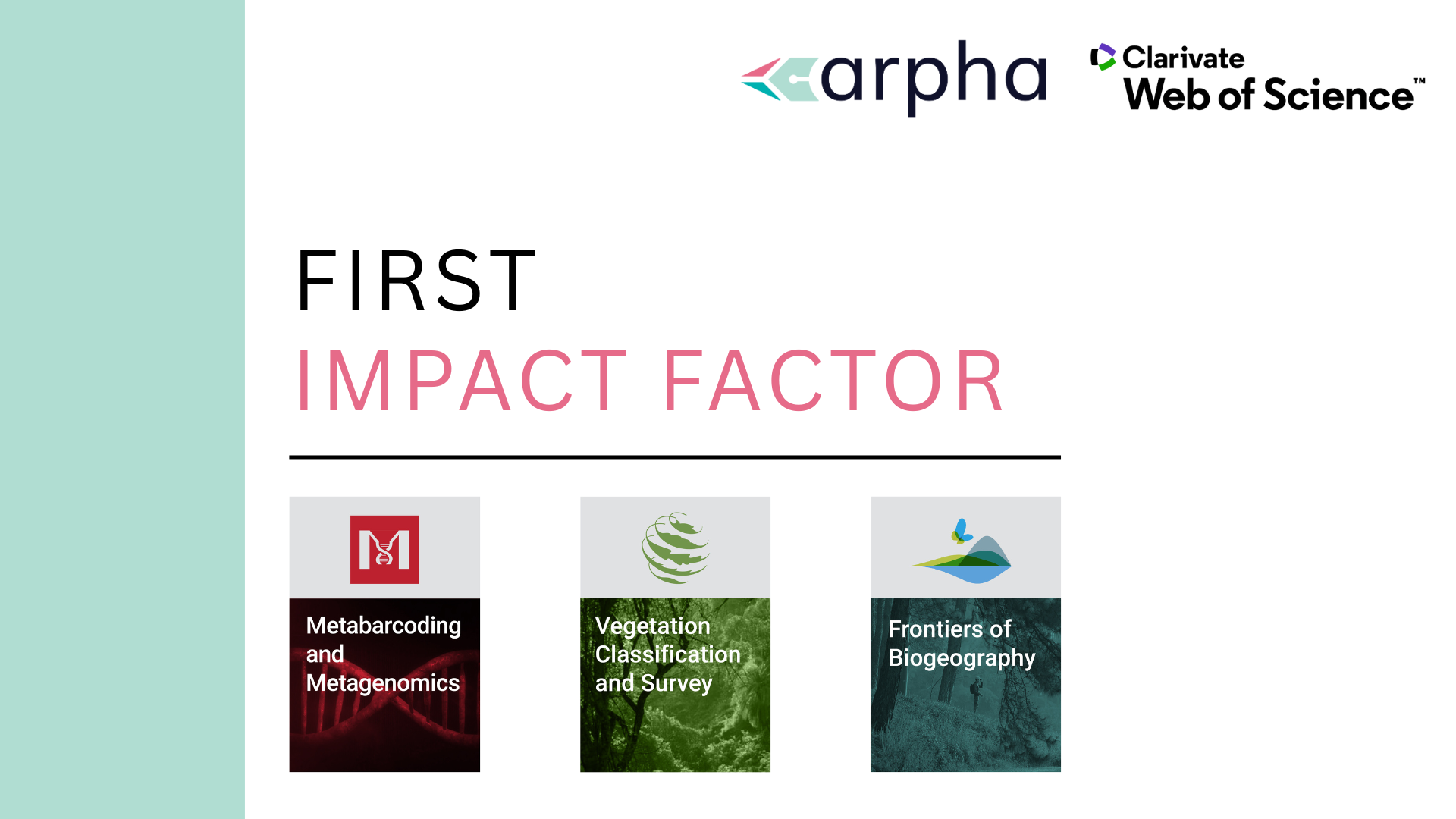
First Impact Factors for three ARPHA-hosted journals

The latest Journal Citation Reports, released by Clarivate in June 2025, have granted three ARPHA-hosted, open-access journals their first Journal Impact Factors (JIF).

Metabarcoding and Metagenomics (MBMG), Vegetation Classification and Survey (VCS), and Frontiers of Biogeography (FoB) achieved impressive scores of 3.1, 3.0, and 2.5, respectively, highlighting their growing impact and relevance to the academic community.

The metric reflects the number of times a journal’s content from 2022 and 2023 was cited in 2024. This total citation count is then divided by the number of “citable” articles (i.e., research and review articles) to estimate the JIF.

This achievement reflects the hard work of the editorial teams and authors at each of the journals, as well as the efforts of ARPHA’s dedicated, in-house indexing team, who help journals apply for important academic indexing databases, including Web of Science and Scopus. Indexation in such databases allows journals to become eligible for metrics like the JIF and CiteScore, which are often considered by researchers deciding where to publish their work.

ARPHA’s indexing service includes evaluation of a given journal’s current status against the requirements of prestigious databases, advice on how to meet these requirements, and overall assistance in the application process. 

Want to know more? Learn about indexing and numerous other services, both automated and human-provided, offered by ARPHA here.

“The Impact Factor is an important metric for scientific metrics. And we know that not having one hinders especially early career researchers to submit their research to us earlier. Therefore, we are very happy that MBMG has received this important metric, and with a value of 3.1 we’re even more happy that this is a very competitive one.”

Florian Leese, MBMG Editor-in-Chief.

“We are delighted to see the journal receive its first Impact Factor. We expect that both Journal Impact Factor and CiteScore will further increase in 2026.
“Thanks to all our editors, reviewers and authors who made this success possible and to IAVS for subsidizing the APCs of VCS during the first few years. We look forward to receiving more high-quality submissions in the fields of vegetation classification and ecoinformatics, the two strongholds of VCS.”

Jürgen Dengler, Idoia Biurrun and Wolfgang Willner, VCS Chief Editors.

“When The International Biogeography Society launched Frontiers of Biogeography under the editorship of Joaquín Hortal in 2009, we had a vision of it becoming an adaptable, independent, society-owned journal with a distinctive place in the journal publishing landscape. The attainment of our first Clarivate Journal Impact Factor is testimony to the hard work by our past and present editors and reviewers, and to the quality and interest level of the work that our community has entrusted to the journal for publication.
“Working together with the team at Pensoft we are confident that we can continue to grow the journal as a favoured venue for Open Access publication of cutting-edge biogeographical research.”
Robert J. Whittaker, Frontiers of Biogeography Editor-in-Chief.

New open-access journal Metabarcoding & Metagenomics joins the lines of ARPHA and Pensoft

A new innovative open-access academic journal Metabarcoding and Metagenomics (MBMG) is launched to welcome novel papers from both basic and applied aspects.

Focusing on genetic approaches to study biodiversity across all ecosystems, MBMG covers a considerably large scope of research including environmental, microbial and applied metabarcoding and metagenomics (especially DNA-based bioassessment and -monitoring, quarantine, nature conservation, species invasions, eDNA surveillance), as well as associated topics, such as molecular ecology, DNA-based species delimitation and identification, and other emerging related fields. Submissions of bioinformatic approaches to MBMG (algorithms, software) are also encouraged.

Featuring novel article formats and data publishing workflows, MBMG is to reflect the rapid growth in the use of metabarcoding and metagenomics in life and environmental sciences.

Issued via ARPHA – the first ever publishing platform to support manuscripts all the way from authoring to peer review to publication and dissemination, designed by the academic publisher and technology provider Pensoft, the new journal is to host a wide range of outcomes from across the research cycle, including data, models, methods, workflows, software, perspectives, opinions, implementation strategies, as well as conventional research articles.

While the above-mentioned publication types are already available in other journals published on the ARPHA platform, such as Research Ideas and Outcomes (RIO)Biodiversity Data Journal and One Ecosystem, MBMG provides five extra domain-specific article types, namely: Emerging Technique, Applied Study, DNA Barcode Release, Primer Validation and Probe Validation.

The journal’s articles are to be available in three formats (PDF, XML, HTML) and full of semantic enhancements for better human- and machine-readability and discoverability. The XML-based workflow also ensures that content and data are available for extraction, indexing and re-use immediately after publication.

With Pensoft standing for transparent, reproducible and open science, the authors at MBMG are strongly encouraged to make all data publicly available either within the publication itself, or to link to external repositories. In their turn, the peer reviewers are also suggested to provide public access to their reviews and identities.

In time for the launch, MBMG has already gathered a team of experienced and renowned scientists from across the globe together on its editorial and advisory board.

“I am pleased to introduce the Metabarcoding and Metagenomics journal to the family of Pensoft,” says Prof. Lyubomir Penev, Founder and Managing Director at Pensoft. “With its exhaustive scope and advanced services and concept, I believe it fills fantastically a niche in our strong portfolio of mostly biodiversity- and ecology-themed journals.”

“Metabarcoding and metagenomics approaches are rapidly progressing and revolutionise research and its application alike,” Chief Editor Prof. Florian Leese states. “With the MBMG journal we provide an ideal platform to respond to this rapidly growing field, nucleate the emerging knowledge and stimulate further development.”

The first batch of research papers published in MBMG are now available on their new website.

MBMG not only complements the range of journals in the field of molecular environmental life sciences, but also stands out as a novel outlet providing several unique features designed to help researchers to prepare for, and professionally deal with, the massive “deluge” of data,” reads the Editorial.

To celebrate the launch, MBMG starts with a tempting offer to potential authors: publishing will be completely free of charge during the beginning stages of the journal.

###

Follow Metabarcoding and Metagenomics on Twitter | Facebook.