
Contributions to Entomology now indexed in Scopus

Contributions to Entomology, one of the open-access, peer-reviewed journals of the Senckenberg Society for Nature Research, has been officially indexed in Scopus, one of the world’s leading abstract and citation databases for scholarly literature. This achievement ensures broader visibility and discoverability of articles published in Contributions to Entomology.
Cover of "Contributions to Entomology" journal, featuring a grasshopper and announcing its indexing in Scopus.

“Being indexed in Scopus is a great step forward for Contributions to Entomology. Scopus is one of the leading abstract and citation databases for peer-reviewed literature, and being included means the journal’s articles are now more visible, easier to discover, and better integrated into the global research landscape. It reflects the steady progress we’ve made since the beginning of the year—with stronger submissions, growing readership, and a clear focus on quality,” comments Co-Editor-in-Chief Jana Hoffmann of the Senckenberg German Entomological Institute (SDEI).

“Backed by SDEI, with a dedicated editorial team and an engaged community of authors and reviewers, the journal continues to evolve. We are particularly pleased to see this recognition of our collective efforts. This milestone is encouraging—and an important part of the journal’s continued development,” adds Co-Editor-in-Chief Thomas Schmitt.
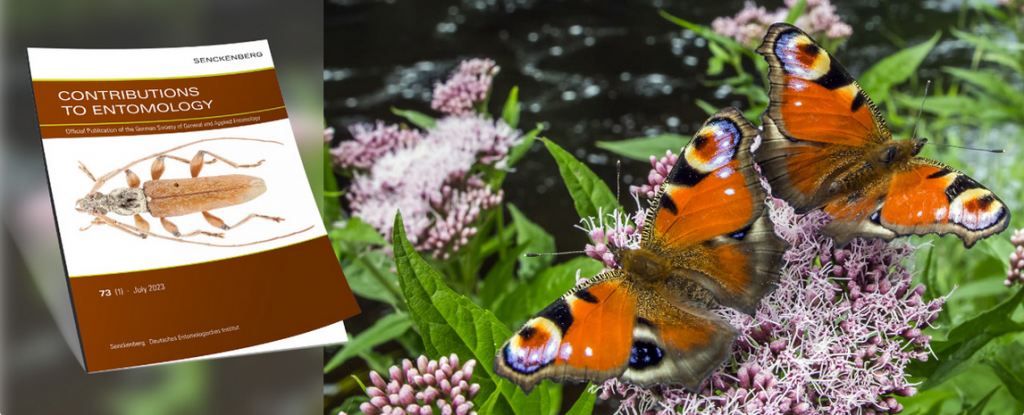
A journal cover titled "Contributions to Entomology" alongside two colorful butterflies on pink flowers.

The Scopus index has rigorous standards for editorial quality, academic contribution, and publishing ethics. Criteria include immaculate peer-review and editorial processes, a good and consistent yearly publication volume, high-quality and user-friendly website and infrastructure, well-pronounced internationality and inclusivity, and considerable readership and citation rates.

The journal is expected to receive its very first Scopus Citescore in June 2026.

Founded in 1951 as Beiträge zur Entomologie by the German Entomological Institute, the journal has evolved over more than seven decades to reflect the growing scope and sophistication of entomological research. Since 2017 (volume 67, issue 1), it has been published as an open-access journal under the title Contributions to Entomology. It is published by the Senckenberg German Entomological Institute in Müncheberg and serves as official publication of the German Society for General and Applied Entomology (DGaaE).

Contributions to Entomology publishes research covering all aspects of entomology, including insect systematics, taxonomy, phylogeny, zoogeography, faunistics, ecology, applied entomology, entomological bibliography, and the history of entomology. The journal operates under a diamond open-access model, ensuring its published content is free to publish and read.

“As a fully open-access journal, we’re committed to supporting accessible and transparent science,” Jana Hoffmann comments.

In 2021, Contributions to Entomology signed with Pensoft to move the journal to the scientific publisher’s ARPHA Platform, in a move to modernise the academic outlet and provide its authors, readers and editors with a user-friendly environment where they can submit, revise, publish and permanently archive their work.
First Journal Impact Factor for One Ecosystem

For the first time, the Journal Citation Reports™ – released by Clarivate in late June 2024 – features the open-access scientific journal One Ecosystem. The inaugural Journal Impact Factor for One Ecosystem stands at 1.8.

The 2024 report reflects how many times content published in a particular journal in 2021 and 2022 was cited in the last complete year: 2023. Then, this total count is divided by the number of “citable” (i.e. research and review) articles to estimate the JIF for 2023.

The news comes shortly after the journal specialised in ecology and sustainability data received a Scopus CiteScore of 4.6. In comparison to Clarivate and the Journal Impact Factor, Scopus uses data from its own database and calculates its CiteScore based on publications and citations from the last four complete years.

One Ecosystem was launched in 2016 by open-access scholarly publisher and technology provider Pensoft in collaboration with Editor-in-Chief Prof. Dr. Benjamin Burkhard (Head of the Physical Geography & Landscape Ecology section at Leibniz University Hannover, Germany), and Deputy Editors-in-Chief Prof. Dr. Davide Geneletti (Department of Civil, Environmental and Mechanical Engineering, University of Trento, Italy) and Dr. Joachim Maes, (Directorate-General for Regional and Urban Policy of the European Commission). Since the beginning it has been associated with and endorsed by the global Ecosystem Services Partnership.

Amongst the unique features of the journal are the collaborative writing and review environment integrated within the manuscript submission workflow to allow for heavily automated structured data import; semantically enriched publications; and field-specific article formats, such as Ecosystem Service Mapping; Ecosystem Service Models; Ecosystem Accounting Table; Monitoring Schema.

“Since day one, One Ecosystem has been widely praised in the community for its novel and data-driven approach to ecology and sustainability science, coupled with a straight-forward and low-cost open-access scholarly publishing strategy for any researcher in the world. Now, the recognition by Web of Science and Scopus provides the journal with further proof of its top quality and research integrity that – I expect – will attract even more researchers in the field to submit their work to the journal”  

says Editor-in-Chief Benjamin Burkhard.

Content published in One Ecosystem can be found in over 60 leading academic indexing databases, including Scopus, Research Gate, DOAJ, Cabell’s Directory, CABI, ERIH PLUS, CNKI, Unpaywall and OpenAIRE. It is also archived in CLOCKSS, Zenodo, Portico and Zendy.

***

Visit the One Ecosystem journal website at: https://oneecosystem.pensoft.net.

You can also follow One Ecosystem on X (formerly Twitter) and Facebook.