
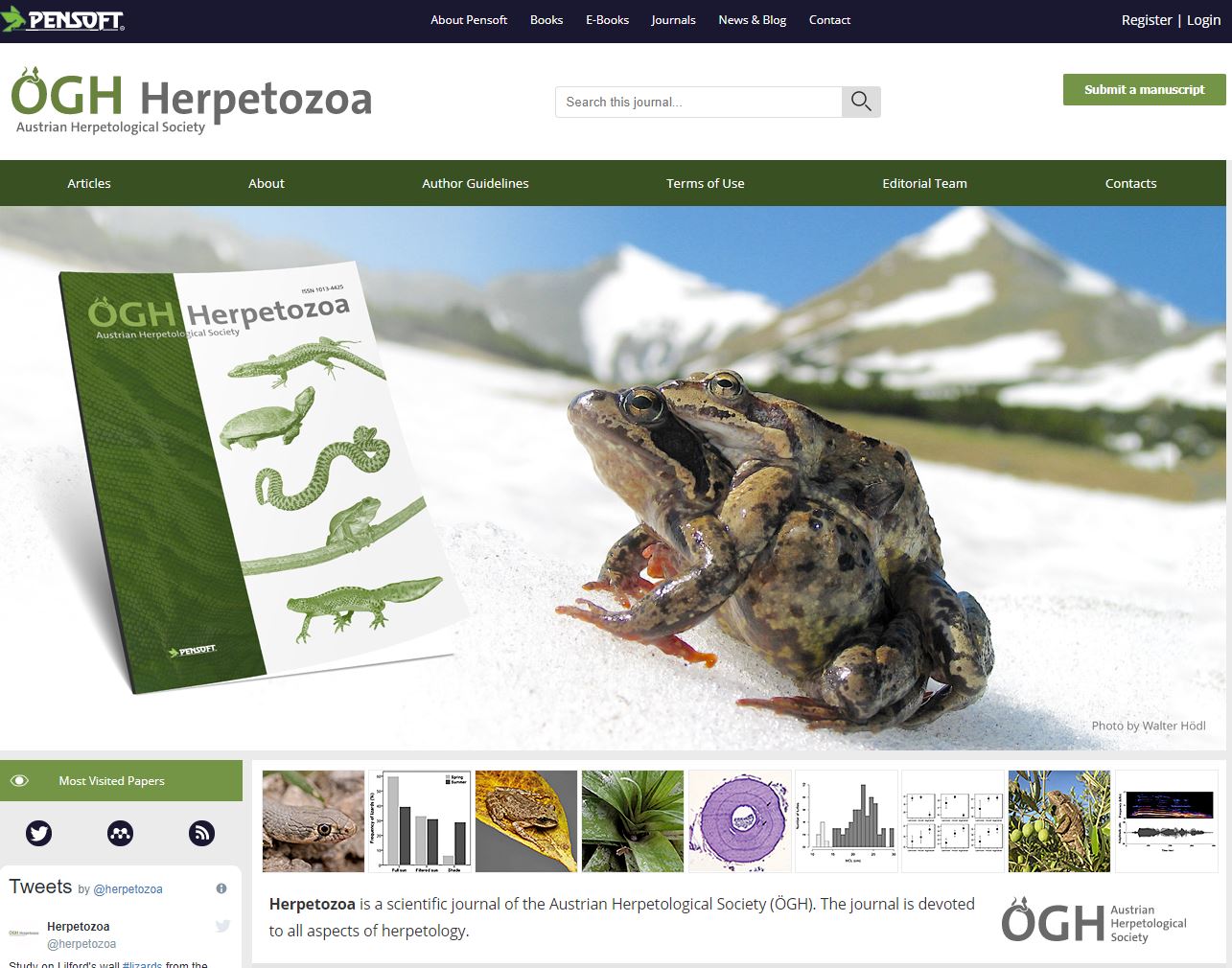
Austrian Herpetological Society’s journal Herpetozoa moves to Pensoft’s ARPHA platform

Newly published research articles demonstrate numerous innovative features to the benefit of readers, authors and all other users

Follow Herpetozoa on Twitter and Facebook.

Published since 1988 by the Austrian Herpetological Society (ÖGH, Österreichische Gesellschaft für Herpetologie), the renowned peer-reviewed, open-access Herpetozoa is added to the growing portfolio of international scientific journals published on the ARPHA scholarly platform, as a result of a new partnership with scholarly publisher and technology provider Pensoft.

As before, Herpetozoa welcomes original research articles, short contributions and reviews covering all aspects of the study of amphibians and reptiles. The papers are published in English, whereas a translation of the abstract into German may also be included. The journal operates a single-blind peer review policy.

Seen in the first 2019 publications of Herpetozoa, now available on a brand new website, is a long list of innovative features designed to promote visibility, access, reuse and citability of the scholarly outputs.

Right underneath the new sleek look and feel welcoming users from the journal’s homepage, there are a lot of high-tech perks to benefit authors, readers, reviewers and editors alike.

Thanks to the fast-track and convenient publishing provided by ARPHA, each manuscript is carried through all stages from submission and reviewing to dissemination and archiving without ever leaving the platform’s collaboration-friendly online environment.

Furthermore, all publications are available in three formats (PDF, XML, HTML), complete with a whole set of semantic enhancements, so that the articles are easy to find, access and harvest by both humans and machines.

Editor-in-Chief of Herpetozoa, Dr Günter Gollmann states:

“We decided to move to Open Access online publishing to increase the visibility of our journal, and to speed up the publication process. The highly attractive presentation provided by Pensoft should boost attention for the papers we publish. While Herpetozoa welcomes contributions of any length on all topics in herpetology, I hope that authors will appreciate the suitability of the new format for data-rich studies in natural history. Such research is often dismissed as “too descriptive” by other international journals, but is essential for conservation of biodiversity,”


ARPHA’s and Pensoft’s founder and CEO Prof Lyubomir Penev says:

“I am pleased to see Herpetozoa having found its new home on the ARPHA platform amongst all Pensoft journals and other highly reputed academic titles from around the globe. With our own strong background in zoological sciences, I am certain that our partnership with Herpetozoa will be quick to prove fruitful to both of us, but most importantly, to all readers, authors, editors and reviewers alike.”

With its move to the open-access, technologically advanced scholarly publishing platform, Herpetozoa lines up next to historical and well-known society journals, including Deutsche Entomologische ZeitschriftAlpine Entomology (previously Journal of the Swiss Entomological Society), Journal of Hymenoptera ResearchZoologia and others, which have all chosen to modernise with the help of ARPHA.

What’s new on Herpetozoa?

Amongst the first batch of articles published in Herpetozoa in partnership with ARPHA/Pensoft, there is an Italian study tracking the long-disputed origin of the Mediterranean-native common chameleon (Chamaeleo chamaeleo) back to its ancestors in North Africa and the Middle East. Another paper by a research team from Romania compares the effects of carnivore, vegetarian and omnivorous diets on the growth, development and mortality in tadpoles of the common toad. In their study of the South American frog species Leptodactylus fuscus, scientists from Universidade Federal de Mato Grosso do Sul (Brazil) compare the diet of a population living in the wild with another one, which inhabits an urban environment. Their aim was to determine the impact urbanisation could be having on this otherwise abundant amphibian.

###

Herpetozoa is indexed in Biological AbstractsBIOSIS (Previews)Current Contents – AgriculturalScience Citation Index (Expanded)Web of ScienceZoological Record (Plus). Currently, its Journal Impact Factor stands at 1.125.

Additional information:

About the Austrian Herpetological Society:

The Austrian Herpetological Society (Österreichische Gesellschaft für Herpetologie, ÖGH) was founded in 1984 to advance all branches of herpetology. The society supports scientific research and promotes conservation of amphibians and reptiles, as well as their habitats. To raise public awareness of these animal groups, ÖGH organizes meetings and excursions and publishes the journals Herpetozoa and ÖGH-Aktuell.
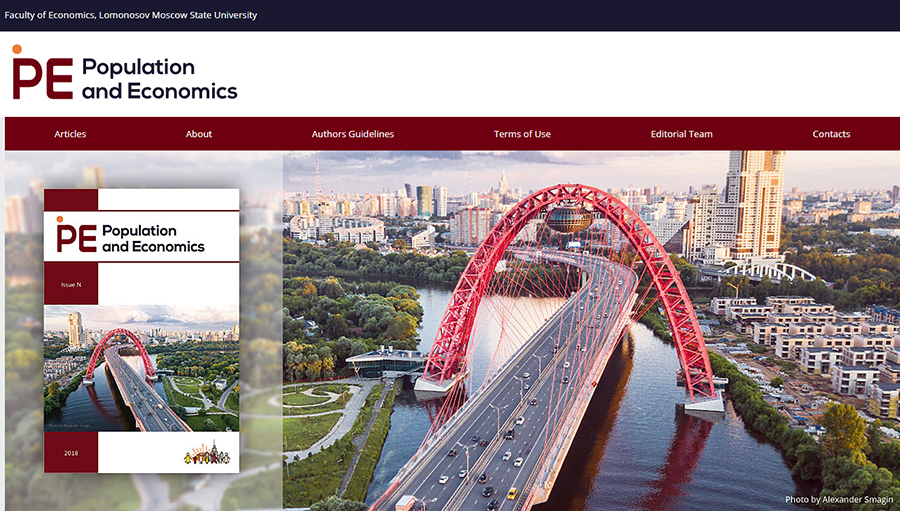
Moscow State University’s journal Population and Economics now published on ARPHA platform

The first 2019 issue of the journal Population and Economics is now published and demonstrates a brand new look-and-feel and high-tech perks

Population and Economics is the latest renowned journal to feature on the growing portfolio of open-access titles making use of the innovative scholarly platform ARPHA. Having taken advantage of ARPHA’s white-label publishing solution, the journal accommodates a long list of high-tech novelties which benefit authors, readers and editors alike. Marking the new partnership is the first 2019 issue of the journal, now available on its brand new website.

Population and Economics is the latest renowned journal to feature on the growing portfolio of open-access titles making use of the innovative scholarly publishing platform ARPHA, developed by scholarly publisher and technology provider Pensoft. The journal’s 2019 inaugural issue and the first since the realisation of the new partnership is already live on the journal’s new website.

Published by the Faculty of Economics at Lomonosov Moscow State University with the support of Derzhava Bank, Population and Economics has the mission to provide the international community with a scholarly platform facilitating the exchange of theoretical and practical knowledge in the study of population development, as well as results from interdisciplinary economic and demographic research.

From now on, further manifesting its dedication to sharing scientific findings on a global scale, Population and Economics is to publish articles in three formats (PDF, XML, HTML) enriched with a whole set of semantic enhancements, so that the papers, along with their data, are easy to discover, access and harvest by both humans and machines from around the world.

The journal is published in English, however, for the convenience of its large audience in Russia, articles are also available in Russian in PDF format. These are accessible from the corresponding paper’s webpage and registered under the same Digital Object Identifier (DOI).

Amongst the other high-tech perks delivered by ARPHA are sophisticated article- and sub-article-level metrics, such as those provided by discovery and analytics-specialised partner Dimensions. The latter allows for the reader to easily look up the publications that have cited the particular paper, as well as their distribution over time and across research categories.

Additionally, beneath the sleek and modern interface, there is a long list of services at the disposal of all users of Population and Economics: editors, reviewers, authors and readers alike. In order to ensure that articles are submitted, reviewed, published and disseminated rapidly and conveniently, manuscripts undergo the entire review and publication processes within ARPHA’s seamless online environment.

Submissions of research and review articles, research notes and short communications addressing a range of interdisciplinary topics are all invited at Population and Economics. The journal welcomes analyses and forecasts in the fields of demography, development and reproduction of population, economic demography, health economics, household economics, the economics of inequality, spatial demography and economy, demographic and socio-economic behaviour, applied demography, population policy and social policies amongst others.

The journal operates single-blind peer review, where the reviewers are encouraged to disclose their identities.

All publications are indexed by the Russian Scientific Citation Index (RSCI) and Google Scholar, as well as BASE, CNKI, CrossRef, Dimensions, Mendeley, Microsoft Academic, Naviga (Softweco), OCLC WorldCat, OpenAIRE, OpenCitations, ReadCube, Unpaywall. The articles will be archived at CLOCKSS, Zenodo and Portico.

“I am delighted to see our collaboration with Population and Economics already in the flesh,” says ARPHA’s and Pensoft’s founder and CEO Prof. Lyubomir Penev. “Now that the first ARPHA-published issue of this valued journal is live, I can say with confidence that we are observing the wonderful beginning of a prolific and future-oriented partnership.”

Editor-in-Chief Prof. Irina Kalabikhina adds: “Through our collaboration with the wonderful high-technology publishing platform ARPHA, we are opening a new page in the life of Population and Economics. Published since 2017 in English and Russian, our journal has been bringing authors and readers together, in order to support an interdisciplinary approach to the study of population economics. I am certain that our further cooperation will make the journal more recognisable within the global scholarly community, expand the geography of the participants in the scientific discussions and secure access to novel research results.”

About Faculty of Economics, Lomonosov Moscow State University

Founded in 1941, the Faculty of Economics continues the centuries-old tradition of economic education in Russia, being one of the leading university-level centres in the field of Economics. The faculty combines fundamental education and professional training in order to develop its students’ analytical skills and creative thinking, thereby helping its graduates to adapt quickly and successfully to the requirements of any job in the field of economics.

About Lomonosov Moscow State University

Founded in 1755 by Russian polymath, scientist and writer Mikhail Lomonosov, the university is currently the highest-ranking Russian educational institution, according to the 2018 QS World University Rankings. It is also considered to be the most prestigious university in the former Soviet Union. Every year Moscow University enrolls about 4 000 international students and postgraduates from all over the world.

Articles published in journals on ARPHA indexed by ReadCube for easier discoverability

While research outputs are being published at a rate greater than ever, it is becoming more and more likely to simply pass by the study that is most relevant to your particular interest. This is where ReadCube comes to aid. Now, thanks to the new partnership between ARPHAand ReadCube, all articles in the journals published on Pensoft‘s ARPHA platform, have been indexed and therefore, easily discoverable via ReadCube’s free web, desktop and mobile apps.

“Our mission is to ensure that scholarly literature is not only easily discoverable but also that each article itself is seen as a conduit for deeper discovery, not simply an endpoint,” said Robert McGrath, CEO at ReadCube. “This collaboration with Pensoft supports both these objectives, and we are thrilled to have them as a partner.”

zookeys

In addition to advanced searchability, all Pensoft articles are also available in ReadCube’s Enhanced PDF format. While maintaining the simple and clean look of a standard PDF at first glance, Enhanced PDFs offer interactive feature connecting the reader to relevant information around the article including supplements, article metric, annotation tools, clickable in-line references and even hyperlinked author names which redirect readers to the author’s historical publications.

“I am pleased to see all journals published on ARPHA, which is to say not only the ones published by Pensoft, but also those that use our white-label journal publishing platform, being indexed by ReadCube,” said Pensoft’s founder and CEO Prof Lyubomir Penev. “As a strictly open-access publisher and technological provider with a strong background in semantic content enrichment, Pensoft has always strived to keep research as accessible and discoverable as possible. We are very pleased to collaborate with like-minded people who have their own innovative view on science to be on hand to anyone who asks for it.”

###

Additional information:

About ReadCube:

ReadCube develops software to make the world of research more accessible and connected – serving researchers, publishers, academic and commercial organizations.

ReadCube’s web, desktop, and mobile reference management apps, including the ReadCube and Papers brands, dramatically improve the ways researchers find, organize, read, share, and cite research literature

ReadCube’s publisher solutions, adopted by over 70 partners to date, include indexing via Readcube Discover, enhanced PDF viewing and sharing via ReadCube Connect, and article-level ecommerce via ReadCube Checkout.