
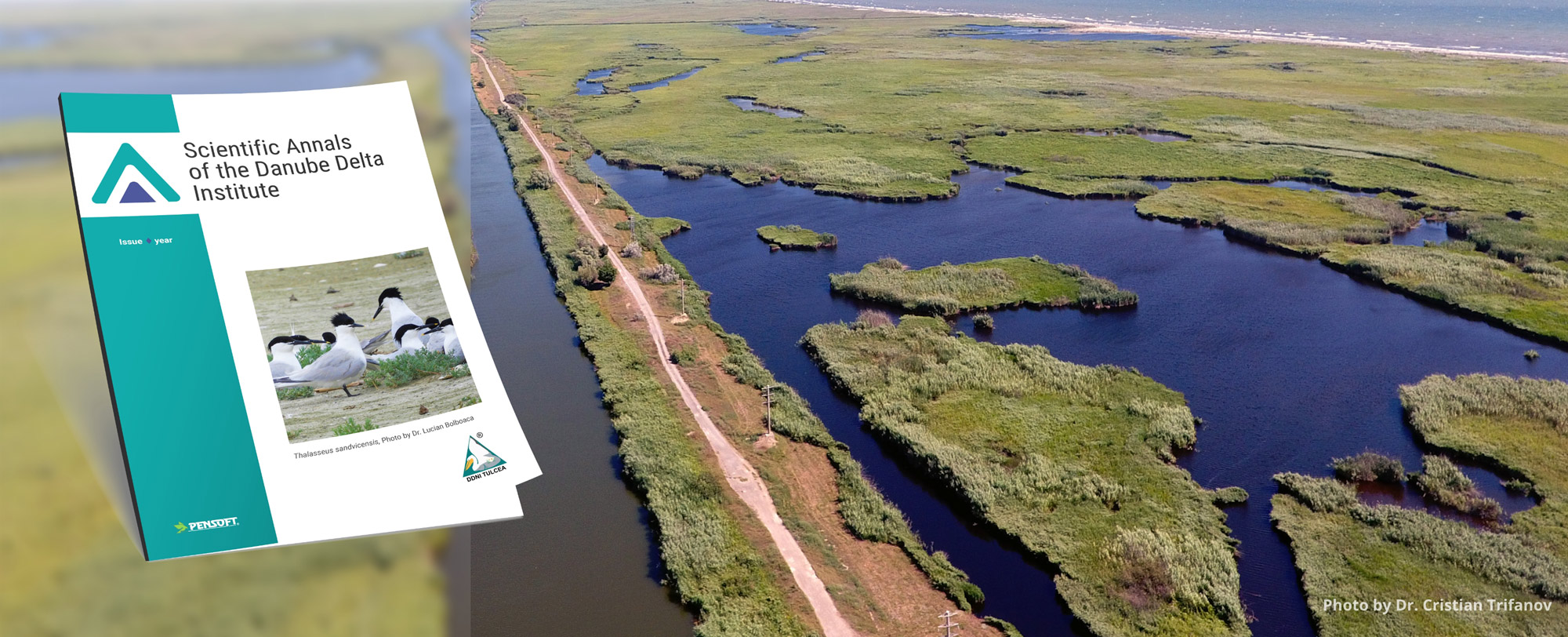
Scientific Annals of the Danube Delta Institute publishes its first articles on ARPHA

The first articles of Scientific Annals of the Danube Delta Institute (SADDI) —the official journal of the Danube Delta National Institute for Research and Development in Tulcea, Romania—have now been published on the journal’s new website following its transition to Pensoft’s ARPHA platform.

Two white spoonbills standing in shallow water, reflecting in the pond, surrounded by lush greenery and scattered debris.
Eurasian Spoonbills (Platalea leucorodia) in the Gandoman Wetlands. Photo by Ruhollah Asgari

The newly published articles focus on supporting the sustainable management of the Danube Delta, including an assessment of the impact of pesticide residues on the river and some insights on the potential of earth observation data for monitoring the Delta. The journal also publishes research on the ecology and biogeography of wetland ecosystems in general, such as a study on the habitat and behaviour of the Eurasian Spoonbill (Platalea leucorodia).

Established in 1993, the journal offers a multidisciplinary platform for studies in the fields of ecology, biodiversity, environmental protection, hydrology, ichthyology, ornithology, limnology, and sustainable development related to wetlands and deltaic environments. It is free to publish and open for submissions.
“With the launch of the first articles in Volume 30 of the Scientific Annals of the Danube Delta Institute, now published with Pensoft, we celebrate an important milestone in advancing research on biodiversity, aquatic ecology, and data integration,” said the journal’s Editor-in-Chief Iuliana-MihaelaTudor of the Danube Delta National Institute for Research and Development.

“This new stage reflects not only the scientific value of the contributions, but also the collaborative spirit that strengthens our community and drives innovation forward.

“As Louis Pasteur once said, ‘Science knows no country, because knowledge belongs to humanity, and is the torch which illuminates the world.’

“We warmly invite our readers, authors, and collaborators to explore this volume, to share in the exchange of ideas, and to continue building together a future where open science connects and empowers us all.”
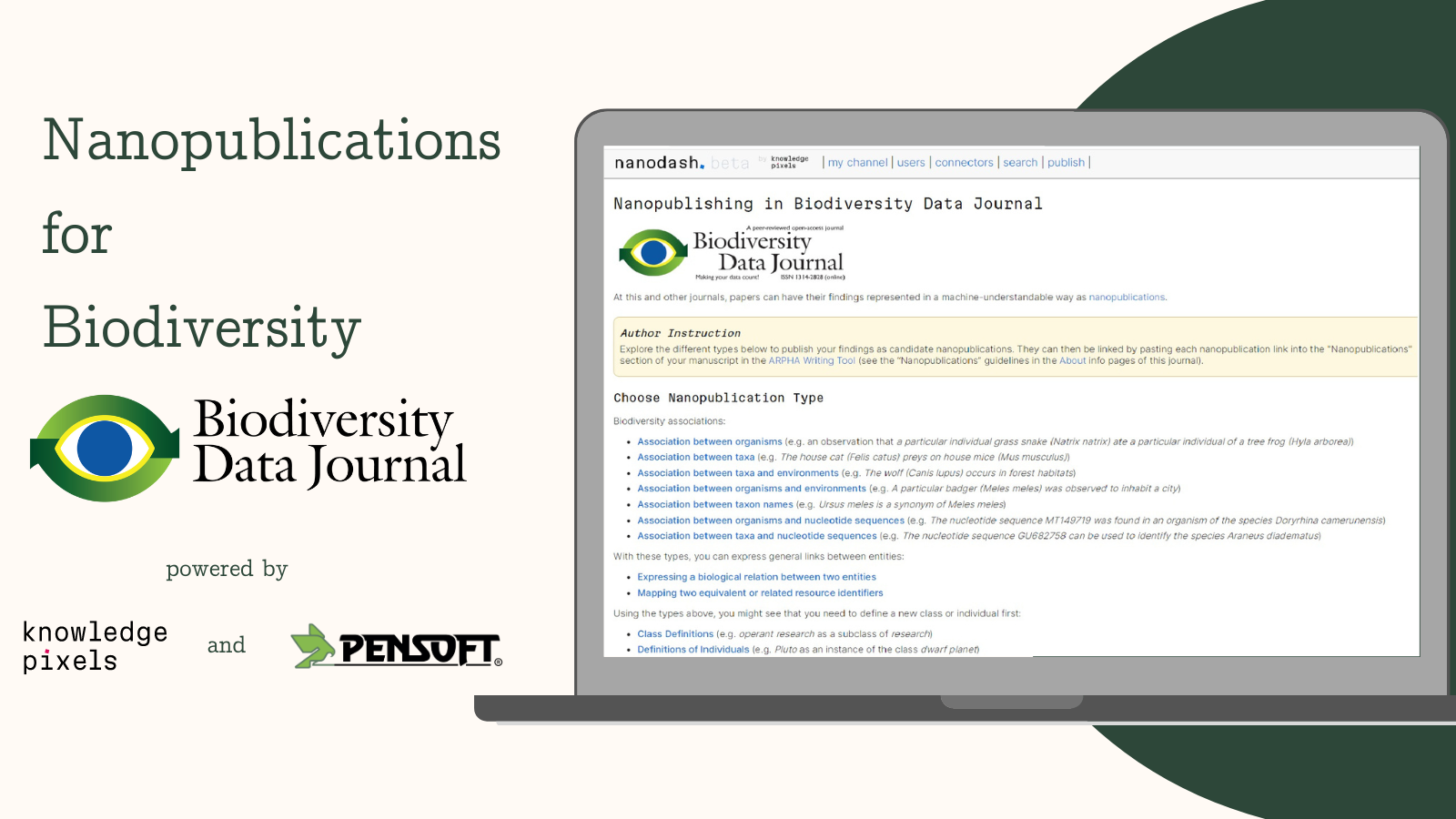
FAIRer knowledge about biodiversity with AI-friendly nanopublications at Biodiversity Data Journal

Earlier this year, in a pilot project, the teams of high-tech startup Knowledge Pixels and open-access scholarly publisher and technology provider Pensoft released a novel workflow to publicly share and future-proof scientific findings by means of nanopublications.

Nanopublications complement human-created narratives of scientific knowledge with elementary, machine-actionable, simple and straightforward scientific statements that prompt sharing, finding, accessibility, citability and interoperability. By making it easier to trace individual findings back to their origin and/or follow-up updates, it also helps to better understand the provenance of biodiversity data.

These semantic statements expressed in community-agreed terms, openly available through links to controlled vocabularies, ontologies and standards, are not only freely accessible to everyone in both human-readable and machine-actionable formats, but also easy-to-digest for computer algorithms and AI-powered assistants.

Now, the collaborators – also partly supported by the Horizon 2020-funded project BiCIKL (abbreviation for Biodiversity Community Integrated Knowledge Library) – have built up on a pilot workflow already launched in the Biodiversity Data Journal – to create a specialised nanopublication solution to address the need for FAIR (Findable, Accessible, Interoperable and Reusable) data in the biodiversity science domain. 

In their studies, researchers need to use and refer to extensive and diverse biodiversity data at once, e.g. information about groups of organisms and their classification, collections, authors and genetic sequences. However, those would normally be scattered across a vast number of articles or belong to dissociated databases. This is a major and widely recognised issue in biodiversity science, which is currently stagnating progress not only in building up the world’s knowledge about the natural world around us, but also impeding biodiversity conservation and ecosystem restoration.

Using the newly released nanopublication workflow, biodiversity researchers can now incorporate nanopublications within their manuscripts to future-proof their most important assertions on biological taxa and organisms or statements about associations of taxa or organisms and their environments. 

In addition, the authors can also create standalone nanopublications that comment or derive from already existing research journals published in an academic journal or another citable source (e.g. expert database), regardless of the author of the source. 

“With the nanopublication format, authors make sure that key scientific statements – the ones underpinning their research work – are efficiently communicated in a machine-actionable and FAIR manner. Thus, their contributions to science become future-proof for a reality driven by AI technology,”

explains Prof. Lyubomir Penev, founder and CEO at Pensoft.

“Biodiversity is the ideal field for this pilot exploring the next steps in scientific publishing. Biodiversity and its neighbouring fields have produced a remarkable number of high-quality resources, such as controlled vocabularies and databases, which we can now build upon. Moreover, many Biodiversity researchers have shown to be very open to such new methods and are enthusiastic about working together to build a more powerful ecosystem for scientific knowledge sharing, and we share their enthusiasm,”

says Tobias Kuhn, CTO and co-founder of Knowledge Pixels. 

***

You can find more about the nanopublication workflow and its advantages to biodiversity scientists on the Pensoft blog and the Biodiversity Data Journal website.