

First Journal Impact Factor for European Science Editing

European Science Editing, the official journal of the European Association of Science Editors (EASE), has received its first Journal Impact Factor (JIF) from Clarivate’s Web of Science. Its 2025 JIF stands at 1.6, a key milestone for the journal and a recognition of its growing influence in the scholarly communication community.

Further, the journal ranks in Q2 in Library and Information Science in the Web of Science Core Collection (ESCI).

Prior to this JIF, European Science Editing had already demonstrated strong and growing recognition in Scopus, with its 2025 CiteScore reaching 3.0, up from 2.3 in 2024, ranking in Q2 for Communication and Q3 for Health Informatics.
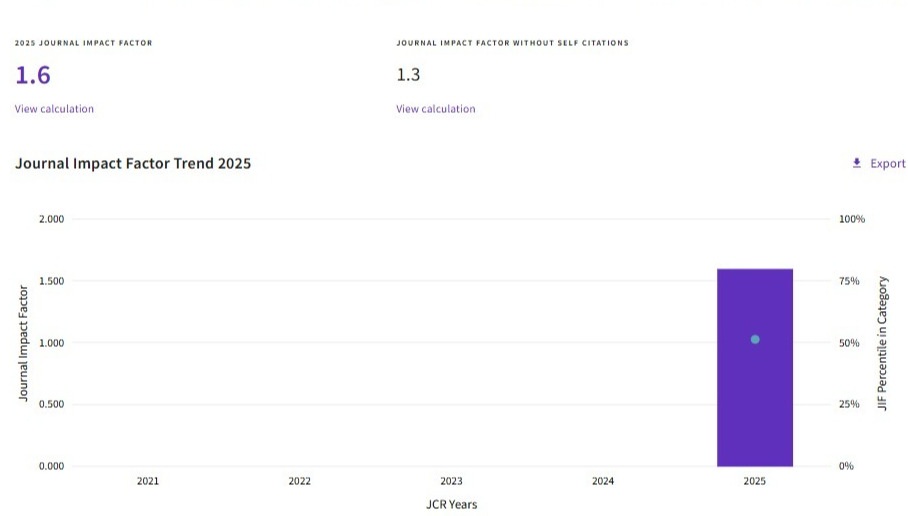
A key metric released by Clarivate, the 2025 Journal Impact Factor reflects the number of times content published in a specific journal during 2023 and 2024 was cited in 2025. This total citation count is then divided by the number of citable articles (i.e., research and review articles) to estimate the JIF.
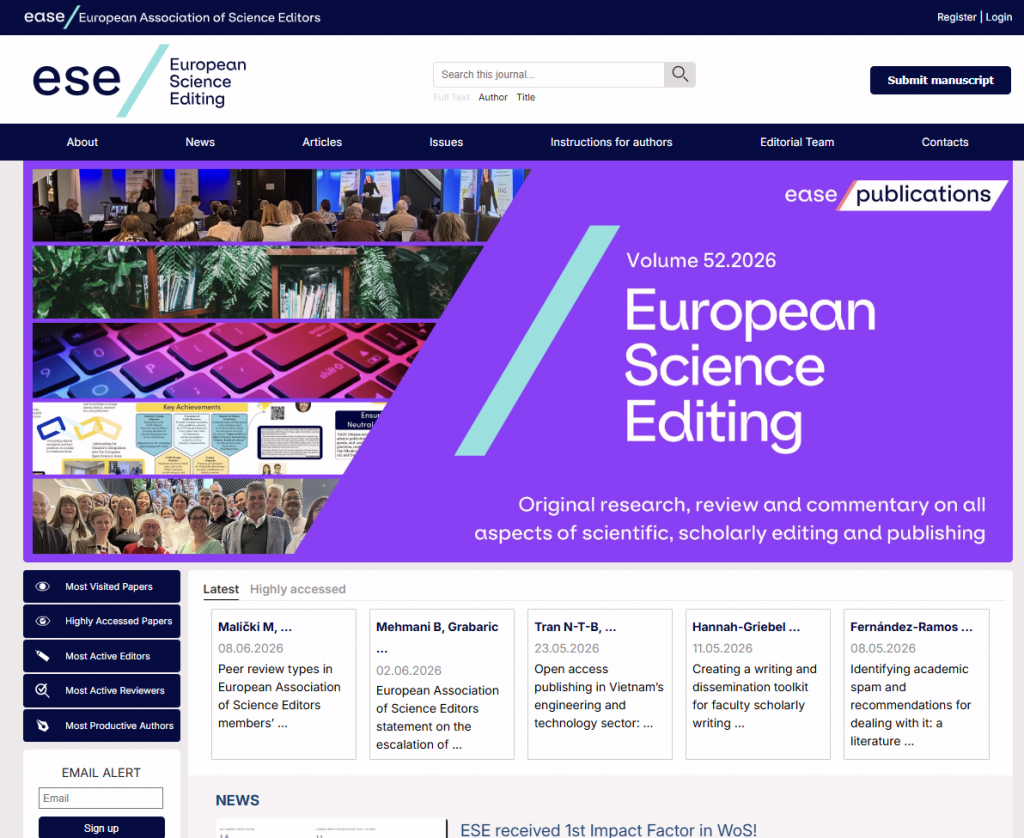
European Science Editing journal homepage.
Journal homepage.

The journal’s history can be traced back to 1986 when it was published as a bulletin. Then, in 2003 European Science Editing was launched as a peer-reviewed journal published four times a year, dedicated to supporting research within the scope of the Association. In January 2020, the journal converted to Diamond Open Access with a rolling publication model on the ARPHA Platform, giving authors greater presence and impact across the membership and the wider scholarly publishing community.

The journal is powered by the ARPHA Platform, a one-stop publishing solution developed by Pensoft that offers a seamless, end-to-end publishing experience encompassing all stages from manuscript submission through to publication, indexation, dissemination, and permanent archiving.

ARPHA’s robust support for academic publishing also includes a variety of human-provided services and integrations with third-party providers, intended to maximise the reach and usability of scholarly knowledge published in European Science Editing.

On this success, the Editor-in-Chief, Ksenija Bazdaric of Rijeka University, reflects:

As Editor-in-Chief of the European Science Editing journal, I am delighted by this result. With the support of ARPHA, we have received our very first impact factor of 1.6. Our Diamond Open Access journal is celebrating this big milestone and its editors and advisory board will work further on raising the journal quality by producing relevant and interesting content for our readership.

Follow EASE on LinkedIn, Bluesky, Facebook and Instagram. You can also follow ARPHA on Bluesky and LinkedIn.

Five journals published on ARPHA with an Impact Factor from 2023

In late July, Clarivate announced that starting from the next Journal Citation Report (JCR) release, expected in June 2023, all journals indexed by the Emerging Science Citation Index (ESCI) and the Arts and Humanities Citation Index (AHCI) will receive an Impact Factor.

So far, the score was only available for journals in the Science Citation Index Expanded (SCIE) and the Social Sciences Citation Index (SSCI).

The news means that the following journals using the ARPHA publishing platform will receive their first Impact Factor next year:

The 2023 JCR report will reflect how many times publications in a particular journal from the Web of Science database have been cited in scholarly articles published in other journals from the same database during 2022. Then, this number will be divided by the number of ‘citable items’ published in the journal in the preceding two years (i.e. research articles, review papers and proceedings papers published in 2021 and 2020).

Note that while citations of any article type are counted in the numerator of the ratio, ‘non-citable items’, such as editorials, letters, obituaries, meeting abstracts and corrigenda, are left out of the denominator.

Can we forecast the Impact Factor?

Unfortunately, we can only guess what the first Impact Factor for any of those journals will be like. 

While you can find the Scopus CiteScore for each of them displayed on the journal’s website homepages, we need to remind you that Web of Science and Scopus use their own databases and apply quite different formulae. 

The Scopus CiteScore is calculated from the number of citations made over the last four completed years divided by the publications from the same years. Apart from a yearly score for the last complete year, Scopus also presents a CiteScoreTracker, whose estimate is updated on a monthly basis.

***

A comprehensive post, published on the independent Scholarly Kitchen blog provides further details and discussion on what the change could mean for journals in the ESCI index. The post also includes a short interview with Dr. Nandita Quaderi, Editor in Chief and Editorial Vice President, Web of Science.  

***

Follow ARPHA Platform on Twitter and LinkedIn

You can also subscribe to the ARPHA blog by entering your email address in the box on the right. 

Biodiversity Data Journal in Science Citation Index Expanded & Journal Citation Reports

Nearly five years after the launch of the innovative, open access scholarly venue, designed to accelerate biodiversity research by closing the gap between narrative and machine-readable structured data, BDJ is formally recognised as one of the high quality journals in its discipline by Clarivate Analytics.

Following a rigorous evaluation process, Pensoft‘s Biodiversity Data Journal (BDJ) was accepted for a range of Clarivate Analytics products and services, including the Science Citation Index Expanded (SCIE) and the Journal Citation Reports, meaning it is to make use of the Journal Impact Factor and related metrics.

Furthermore, articles published in BDJ are to be abstracted in several databases: Agriculture, Biology, and Environmental SciencesZoological RecordBiological Abstracts and BIOSIS Previews, so that the publications are even easier to find by researchers, while citations are continuously tracked, assessed and analysed.

Unlike conventional scholarly journals, BDJ allows for the integrated publication of data alongside text, made possible through highly automated import and conversion of machine-readable structured data into human-accessible format, resulting in a wide range of article types: data papers, species occurrences, species conservation profiles, software descriptions and others. On the other hand, text published in BDJ can be easily downloaded as data or mined by computers for reuse.

“Going beyond the purposes and capabilities of a traditional scholarly journal, or even a data journal, for five years now, BDJ has been successfully demonstrating how much of a valuable scholarly outlet it really is, especially when it comes to publication of data meant to be optimally findable, accessible, interoperable and reusable to the benefit of the field of biodiversity research,” says Prof. Lyubomir Penev, CEO and founder of both Biodiversity Data Journal and Pensoft.

“This recognition from Clarivate is certainly a great reassurance that BDJ has managed to fulfill its mission in proving its worth on the scholarly scene. After all, it comes with the leading usage metrics, in addition to the already featured AltmetricsDimensionsScopus, and article- and sub-article-level statistics,” he adds.

###

About Biodiversity Data Journal:

Biodiversity Data Journal (BDJ) is a community peer-reviewed, open access journal, designed to accelerate publishing, dissemination and sharing of biodiversity-related data of any kind. All structural elements of the articles – text, morphological descriptions, occurrences, data tables, etc. – are treated and stored as data. BDJ aims at integrating data and narrative in the article content to the maximum extent possible. Supplementary data files that underpin graphs, hypotheses and results should also be published with the article or deposited in trusted open access data repositories. The journal provides rich biodiversity data import and export facilities through the ARPHA Writing Tool and Darwin Core Archives.